
Publications
Publications
Filter by Topic1
Research Topics
Filter by Topic
11 publications
![[Column] How to Avoid the Pitfalls of Range-Based NDC Targets](https://ynafojsvljfevwkcitzr.supabase.co/storage/v1/object/public/static/publications/thumbnail/b7ba0ace-5313-4ff2-ab5d-1dbe54be2ff6.jpg)
[Column] How to Avoid the Pitfalls of Range-Based NDC Targets
The government has finalized its 2035 Nationally Determined Contribution (NDC) as a 53–61% reduction from 2018 levels. However, the lower-bound–oriented approach is viewed as prioritizing industrial burdens over scientific evidence. A range-type target risks driving administrative action toward the lower end, leaving the upper target as a symbolic declaration. To ensure industrial competitiveness and policy credibility, institutional improvements—such as setting fiscal and R&D plans based on the upper bound and introducing incentives for overachievement—are needed.

NEXT group has released 2024 annual report
NEXT group has released its inaugural annual report, summarizing key activities and outcomes from 2024.

Analysis of heavy snowfall damage and the need for new statistics as winter weather changes
This issue brief examines the impact of heavy snow damage amid climate change and underscores the urgency of updating statistical standards to reflect modern realities.
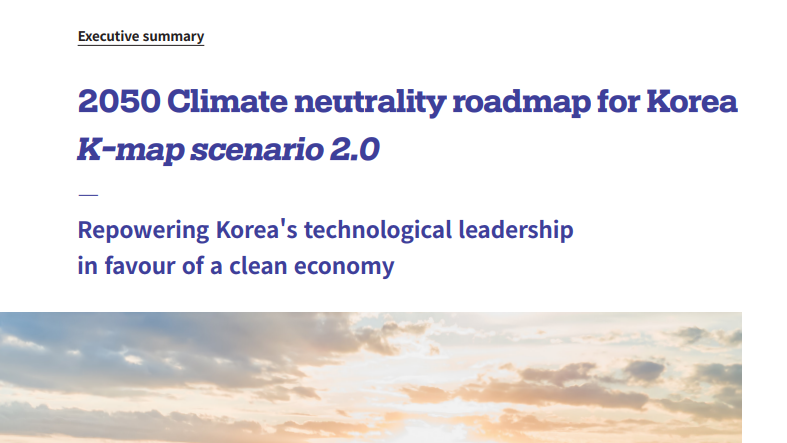
2050 Climate neutrality roadmap for Korea K-map scenario 2.0: Repowering Korea
This study is based on the "2050 Climate Neutrality Roadmap for Korea, K-Map Scenario: Implementing an ambitious decarbonization pathway for the benefit of future generations and the Korean economy" released in February 2022, which examines the potential for additional GHG reductions in five emission sectors: transition, industry, transportation, buildings and agriculture, and analyzes the necessary measures. The results of the analysis for each sector are presented in the order of updating the GHG reduction roadmap, analyzing the potential for additional reductions, and proposing necessary policies, with the aim of analyzing the sectors that need rapid transition to achieve carbon neutrality and strengthening national competitiveness. We hope this report will serve as a useful reference for policy makers and researchers working to achieve carbon neutrality.

The rise of rooftop PV, what should we prepare?: Solutions from the California Case
This issue brief explores alternatives to address the inefficiencies and instability of the electricity grid caused by the growth of behind-the-meter (BTM) generators such as rooftop solar. Encouraging the demand side to operate and manage BTM generators has the benefit of lowering capital and management costs while increasing grid reliability. In California, the state's Net Energy Metering (NEM) 1.0 and 2.0 programs have enabled rapid deployment of rooftop solar, and the recent NEM 3.0 program is sending price signals to incentivize integrated installations with battery storage. In Korea, it is reasonable to induce an increase in the penetration of BTM generators through retail rate compensation levels such as California's NEM 1.0 or 2.0, but to take demand-side measures by establishing a compensation system that can send appropriate price signals to users of BTM generators to control volatility, such as the 3.0 system.
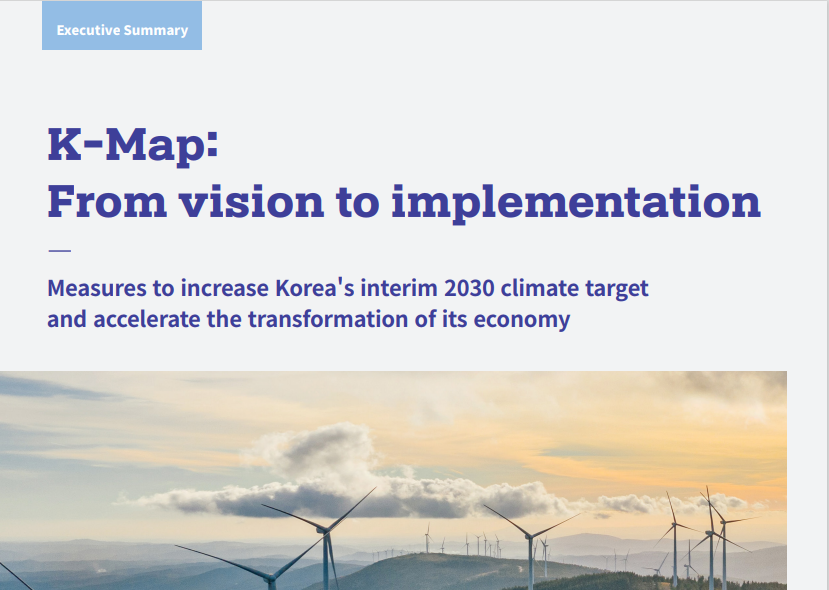
K-Map: From Vision to Implementation_Measures to increase Korea
This report is a combined executive summary of K-Map 2, the sectoral implementation measures of K-Map: 2050 Climate Neutrality Roadmap for Korea published in February 2022 (power, industry, building, transportation and agricultural sectors).

Revisiting Two Myths about Carbon Pricing
This issue brief revisited the two most common misunderstandings about carbon pricing, that it hinders economic growth and kills jobs. The latest research show that if firms’ green-technology adoption and endogenous firm entry are included in an economic model, a rise in carbon prices is only accompanied by a gradual increase in GDP and consumption and a negligible increase in the unemployment rate. To achieve the positive macroeconomic effect of carbon prices while operating carbon pricing instruments (CPIs), 1) CPIs should be designed properly so that carbon prices serve as a clear signal for the technology adoption of firms, and 2) governments should come up with policy and financial supports to recycle the carbon-related revenues for expediting firms’ green technology adoption. To this end, the current emission trading systems should be improved and supplemented to establish actual carbon prices and provide a precise price signal throughout the economy.
Carbon Contract for Difference (CCfD): A First Step for Domestic Discussions
A Carbon Contracts for Difference (CCfD) is a long-term agreement between the government and a company that sets a fixed carbon price (strike price) for a specific project. If the market carbon price falls below the strike price, the government pays the difference; if it exceeds the strike price, the company pays the difference to the government. By ensuring a stable revenue stream, CCfDs reduce uncertainty associated with carbon price volatility, thereby lowering both financing costs and overall project costs. This issue brief provides policy recommendations for the effective design and implementation of CCfDs in the Korean context.

2050 Climate Neutrality Roadmap for Korea: K-Map Scenario
This report presents a more ambitious pathway for Korea to achieve carbon neutrality by 2050. It demonstrates that, through domestic efforts alone, greenhouse gas emissions can be significantly reduced beyond current government targets, while generating substantial economic benefits. The study outlines key strategies—including renewable energy expansion, electrification, and hydrogen use—to guide Korea’s transition toward a sustainable low-carbon economy.
The U.S. Federal Government's Strategy to Accelerate Carbon Neutrality: The Plan for Utilizing Public Purchasing Power
U.S. President Joe Biden signed the "Executive Order on Catalyzing Clean Energy Industries and Jobs Through Federal Sustainability" on December 8, 2021 that outlined the federal government's plan to achieve carbon neutrality by 2050. The U.S. government’s leadership in promoting carbon neutrality through strong public purchasing power sets an example for how government resources and powers can be used effectively. Strengthening the requirement to reflect greenhouse gas emissions in public procurement will make it possible to send price signals to carbon-intensive industries, including manufacturing, and accelerate the transition to a carbon-neutral economy.