
Publications
Publications
Filter by Topic1
Research Topics
Filter by Topic
22 publications
A Big Picture for the Inverter-Dominated Future Grid - Advances in Inverter Technology and Grid Stability
As renewable energy deployment expands, power systems are experiencing various forms of instability, including reduced inertia, voltage control limitations, and resonance issues. This report analyzes how successive generations of inverter technologies affect system stability and outlines the key challenges and technical directions for future power grids.
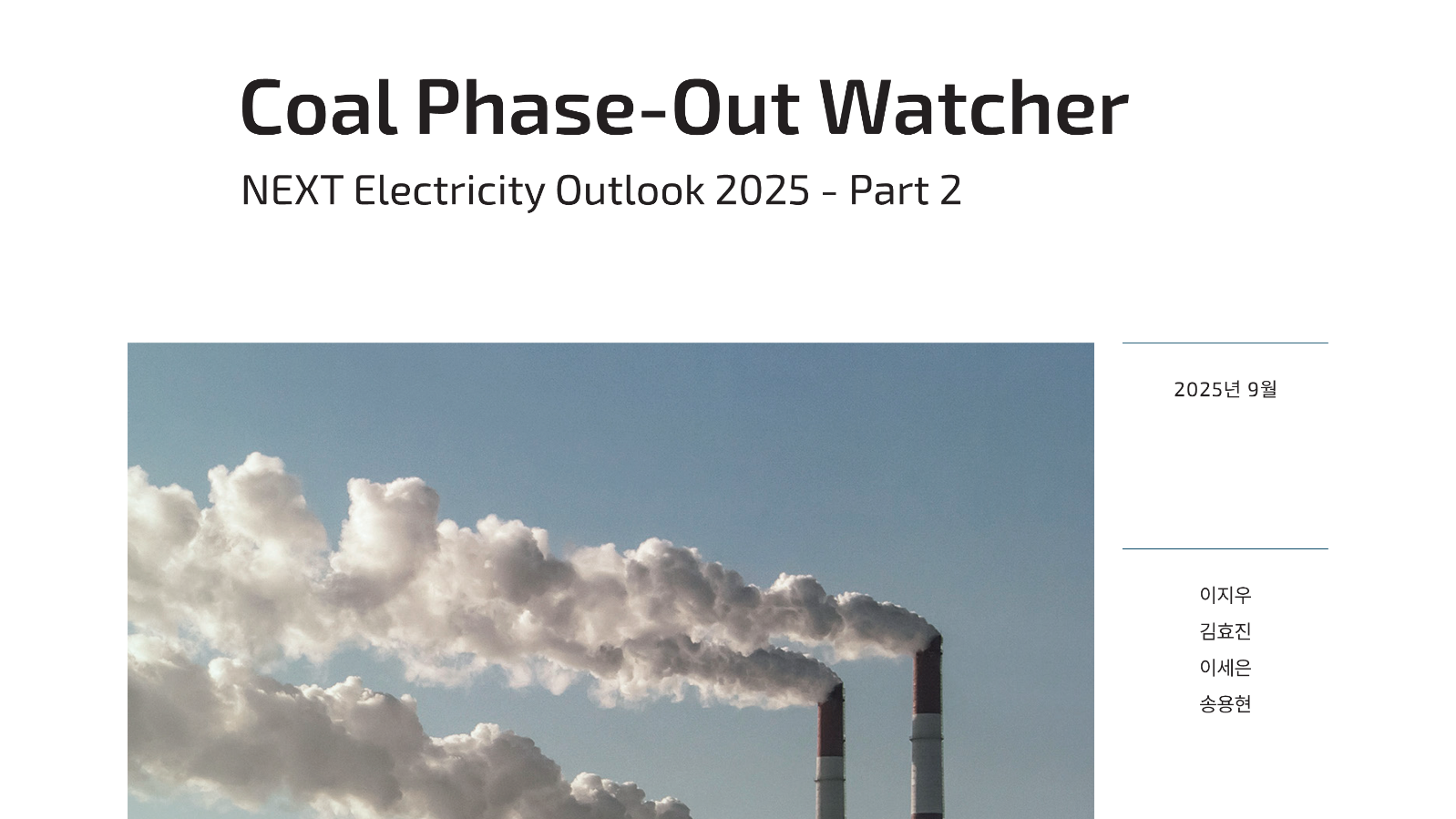
Coal Phase-Out Watcher NEXT Electricity Outlook 2025 - Part 2
This study presents an optimized coal phase-out roadmap that enables coal-fired power plants to maintain economic viability during their remaining operational period. By doing so, it aims to reduce uncertainties and financial risks associated with coal plant operations and contribute to accelerating the transition toward renewable energy.
Offshore grid governance: a prerequisite for timely offshore wind deployment
South Korea, which is still in the early stages of offshore wind power deployment, has yet to establish a clear offshore grid governance system. This issue brief examines the current situation in Korea and international case studies, emphasizing the need for Korea to establish a well-defined offshore grid governance framework.
Solving curtailment issues, starting with data transparency
This issue brief aims to clarify the concept of curtailment for non-power system professionals by analyzing the various causes of curtailment in Korea and introducing examples of curtailment policies and data disclosure from other countries. Based on these analyses, we recommend that transparent data disclosure and clear curtailment policies be established as prerequisites for mitigating curtailment and promoting renewable energy.
NEXT Electricity Outlook 2024 - Part 1: Coal Phase-Out Watcher
This report aims to provide compelling evidence and guidance for policymakers and stakeholders interested in the gradual phase-out of coal-fired power plants (CFPPs). This is the first comprehensive analysis in South Korea, incorporating the latest power system modeling and quantitative data up to 2024, and offering a long-term outlook through 2050. Reflecting global trends towards carbon neutrality and shifts in environmental policies, this report proposes strategies for the power generation mix and identifies essential policies.
Probabilistic Prequalification Scheme of a Distribution System Operator for Supporting Market Participation of Multiple Distributed Energy Resource Aggregators
This paper addresses the need for distribution system operators to effectively manage uncertainties related to distributed energy resources. We propose a probabilistic approach using Polynomial Chaos Expansion, allowing the operator to balance economic efficiency with system reliability by setting a pre-determined acceptable violation probability. Moreover, we introduce a framework for integrating the capability of distributed energy resources aggregators to manage uncertainties through the uncertainty band commodity. Our methodology fairly distributes responsibility for constraint violations among various stakeholders by employing two allocation strategies: one based on Shapley Value and another based on sensitivity factors. The proposed system significantly improves the overall decision-making process by considering both economic and reliability factors within the prequalification process of distribution system operator.
P2P Credit Auction vs. Net Metering: Benefit Analysis for Prosumers under Incremental Block Rate Electricity Tariff
Our study conducts a quantitative analysis how the introducing of peer-to-peer (P2P) trading affects the benefits of each stakeholder, offering a guide for policy adoption. Firstly, we have devised a P2P trading mechanism based on credit auctions tailored for residential, while considering the application of the increasing block rate tariff often applied to residential customers in the real world, and have assessed its benefits in comparison to the current net metering scheme. Multiple case studies were undertaken, encompassing various scenarios, including the level of purchase price of utility for uncleared auction offers, the proportion of prosumers participating in the trading network, and the level of capacity of PV. Our study shows that the P2P trading does not always yield positive benefits for prosumers compared to the prior policy. Nevertheless, we identify specific conditions under which the P2P trading can stimulate residential PV installations.
Korean Power System Challenges and Opportunities: Priorities for Swift and Successful Clean Energy Deployment at Scale
With South Korea’s electricity demand expected to grow 30% by 2035, transitioning to clean energy resources will be critical to reducing power sector emissions and achieving national climate goals. Rapid technological improvements can help keep costs low and maintain grid reliability, provided that Korea’s government takes a coordinated approach to the clean energy transition. This policy brief identifies key barriers to Korea’s shift toward clean energy, based on the companion report A Clean Energy Korea by 2035: Transitioning to 80% Carbon-Free Electricity Generation, interviews with experts, and the latest data and literature. It also explores policy solutions for overcoming technological, economic, and institutional barriers, while suggesting market transformation strategies to accelerate the adoption of clean energy technologies. Amid ongoing cost reductions and technological advances in wind, solar, and energy storage, coordinated implementation of the recommended policy actions could meaningfully accelerate Korea’s clean energy transition.
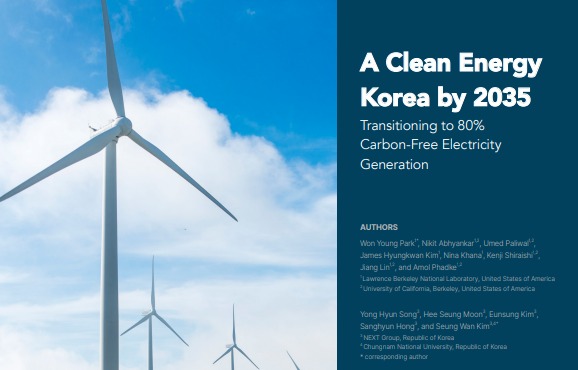
A Clean Energy Korea by 2035 - Transitioning to 80% Carbon-Free Electricity Generation
The current global energy crisis has massive implications for the people and economy of South Korea (Korea), where at least 90% of energy use depends on foreign fossil fuels. Clean electricity accounts for only 39% of total generation, with electricity demand expected to increase 30% by 2035. This study shows that Korea can achieve 80% clean electricity by 2035 by capitalizing on rapid technological improvements and decreasing costs of solar, wind, and battery technology. Doing so would slightly lower electricity supply costs, significantly reduce dependence on imported natural gas and coal, and dramatically cut power sector emissions. Further, this study finds that Korea’s power grid under a clean energy scenario will maintain reliability without coal generation or new natural gas plants. To realize these significant economic, environmental, and energy security benefits, policies such as an 80% clean electricity standard by 2035 and corresponding renewable energy deployment goals are required.
Strategy for Grid Innovation in the UK to Realize a Renewable Energy-Centric System
This issue brief aims to draw policy implications for the power grid of Korea by examining the case of grid innovation in the UK, which has successfully achieved decarbonization of the power sector by establishing a renewable energy-centric power grid despite the constraints of being an island nation. Lessons learned for Korea: The required amount of control resources for system stability should be analyzed based on future scenarios and these control resources should be secured cost-effectively through an auction system. Optimal grid construction plans should be designed by conducting scenario-based economic evaluations and the decision-making processes should be transparently disclosed through reports for public discussion. In order to avoid grid constraint costs and social conflicts associated with onshore transmission line construction while achieving decarbonization of the power sector, Korea should also actively consider the implementation of offshore HVDC.